In Somalia, the federal government’s goal of transitioning from the long-standing indirect electoral system based on 4.5 tribes to a “one person, one vote” model promising stability and a strong state structure marks a new turning point in the country’s history.
Mohammad Ismail Kulane
June 12, 2026•Update : June 12, 2026
MOGADISHU
Somalia, an East African country with a population of approximately 20.3 million, is governed by a federal parliamentary republic model.
The administrative system consists of Puntland, Jubaland, South West, Galmudug, Hirshabelle, the newly created Northwest states, and Somaliland, which unilaterally claims independence.
The transition from the long-standing indirect and tribal-based “4.5 system” to a direct election system based on the “one person, one vote” principle is being described as a historic step.
In the tribal system, people cannot vote directly.
Following the civil war that began in 1991, the country was governed for many years by a tribal-based representation model known as the “4.5 system”.
The four major tribes of Somalia—Hawiye, Darod, Dir, and Digil-Mirifle—each hold a full share of the political power, while all other minority tribes and groups are represented with a shared “half” share.
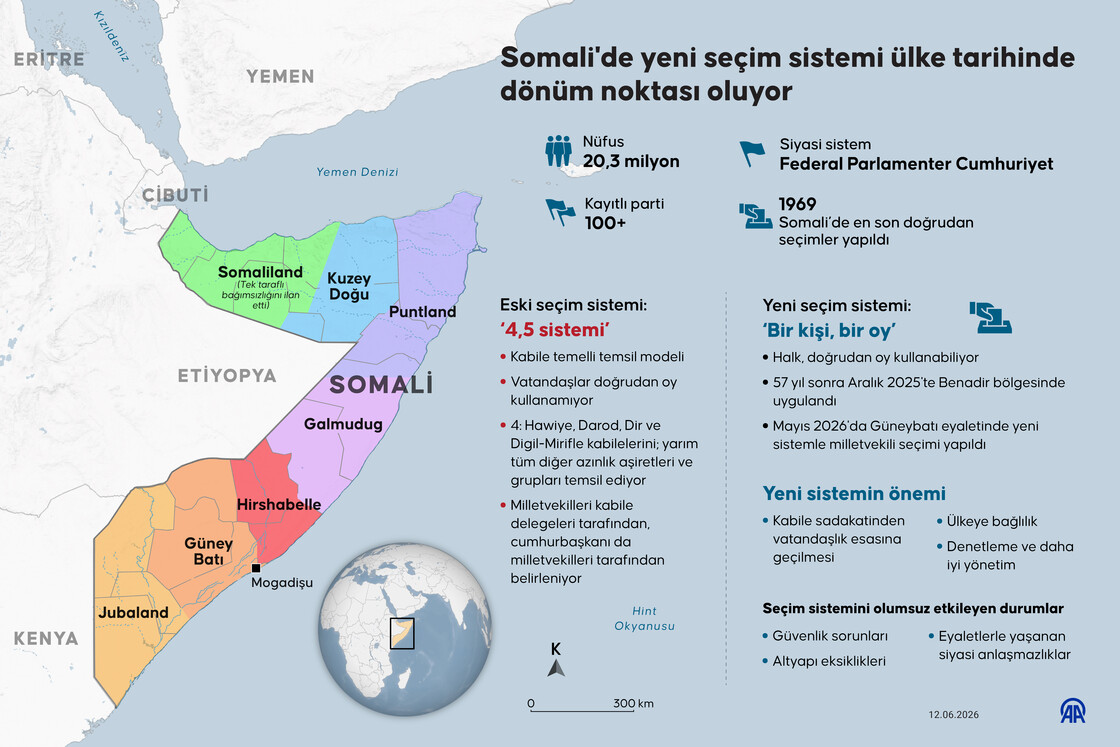
In this system, citizens cannot vote directly; members of parliament are elected by tribal delegates, and the president is determined by these delegates.
President Hassan Sheikh Mahmoud’s administration advocates for a transition to a “one person, one vote” system based on direct popular vote in the country.
The government views this model as a crucial step towards completing the state-building process and strengthening democratization in Somalia.
Indirect elections and direct foreign interventions since 1969.
The last direct elections in Somalia were held in 1969, and following the military coup that same year, the country was unable to hold direct elections for many years.
In Somalia, after the overthrow of Siad Barre’s regime in 1991 and the ensuing chaos, the arrival of the US military between 1992 and 1995 also proved fruitless.
In 2001, Somali elites gathered in Djibouti and, using a system of 4.5 tribes, elected Abdulkasim Salad Hassan as president.
However, the new government established in Djibouti was unable to exercise authority in Mogadishu, and power struggles continued.
While regional intervention continued, at a meeting held in Kenya in 2004, Abdullahi Yusuf, the leader of Somalia’s Puntland region, was installed as president and a federal system was adopted.
Despite Ethiopian support, Yusuf was unable to stabilize his government. With increasing tribal rivalries and pressure from al-Shabaab, his administration resigned.
In meetings held in Djibouti, a decision was made that moved relatively away from direct Ethiopian control and was more in line with local realities, resulting in Sheikh Sharif Ahmed being chosen as the new president in 2009.
In 2009, the Ethiopian army also withdrew from the capital, and was replaced by the African Union’s AMISOM force, which included Ethiopian troops.
In Somalia, which operates under a 4.5-tribal system, Hassan Sheikh Mahmud was elected president in the 2012 elections.
The position, which was taken over in 2017 by former Prime Minister Mohamed Abdullah Mohamed (Farmaajo), a Somali-American citizen, was assumed by Hassan Sheikh Mahmud in 2022.
Hassan Sheikh Mahmoud, who was appointed president for a second term, is still in office.
Direct election process
The direct election system, which was first raised and continues to be debated during Hassan Sheikh Mahmoud’s presidency, became one of Mahmoud’s key promises after his re-election.
Thanks to Mahmud’s initiatives, the country entered a period in which, for the first time, the people directly elected their representatives through voting.
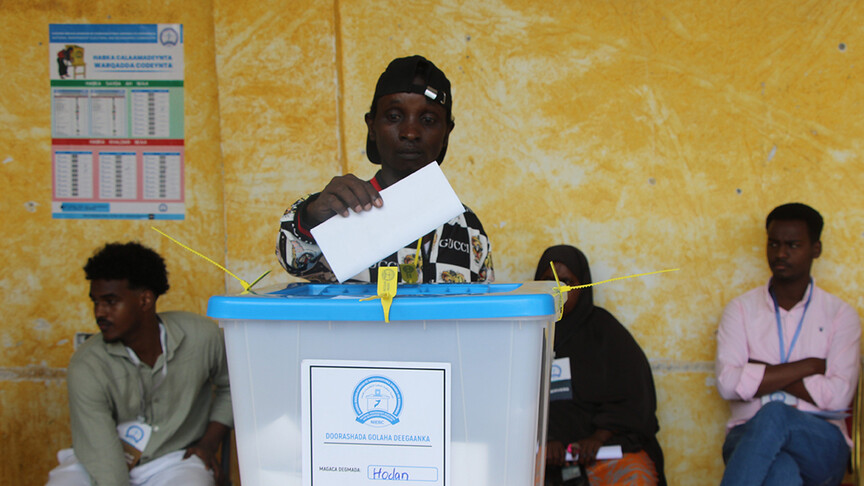
In December 2025, the Benadir region, which includes the capital Mogadishu, implemented the direct election model for the first time in 57 years.
Then, legislative elections were held in the Southwestern state on May 10th.
Thus, the “one person, one vote” electoral system was implemented.
The plan is to implement a model where, after parliamentary elections are held in all states, the presidential election will also take place in the Somali Federal Assembly.
In a system that will extend from regional to federal levels, legislators in the southwestern state yesterday also elected a state governor for a five-year term.
Somali President Hassan Sheikh Mahmud and Somali Minister of Ports and Maritime Transport Abdulkadir Mohamed Nur described the development as “a historic step in Somalia’s democratization process.”
The southwestern province also became the first region outside the capital to hold direct elections.
The system will be supported through political parties.
Political parties first began to emerge in Somalia in 1947, during the period of British rule, but the coup of 1969 and the civil war that began in 1991 hampered their development.
Since 2012, the registration, establishment, and activities of political parties have picked up again, and the number of registered parties has exceeded 100.
The strengthening of political parties is seen as an important tool in transforming the current system, which is a “tribal federation,” into a genuine “nation-state” mechanism.
Transitioning from tribal loyalty to citizenship is vital for Somalia, as it would shift politics based on tribal affiliation to prioritizing services that meet the country’s needs in areas such as the economy, security, education, and health.
One of Somalia’s greatest needs is for national resources and all institutions, from education to security, to be managed through elections rather than being divided among tribes, thus promising a service-oriented system instead of tribal representation.
In this context, it is anticipated that strengthening the political party system will help transform Somalia’s fragmented structure into a unified political organism with shared national goals.
Situations that negatively affect the electoral system
Although the federal government aims for a nationwide electoral system in which citizens can vote directly, security concerns, infrastructure deficiencies, and political disagreements with federal states are cited as major obstacles to the process.
Al-Shabaab, which remains active in some parts of Somalia, continues to clash with Somali security forces, while the governments of Puntland in the north and Jubaland in the south directly oppose elections.
Although these states are under the central government’s control, they act against national unity by holding their own elections independently of the budget they receive from the center.
Nationwide transportation problems and inadequate electricity infrastructure are also negatively impacting the elections.
In the capital, some opposition leaders, such as former President Sheikh Sharif Ahmed and former Prime Minister Hassan Ali Khairi, whose accompanying armed elements clashed with security forces, argue that the “one person, one vote” system cannot be implemented due to the country’s current political and security situation.
According to experts, the new system will support legitimacy and democracy.
Experts speaking to an AA correspondent pointed out that Somalia’s “one person, one vote” electoral system is important for public participation in governance.
Stratmacy Advisory CEO Ahmed Mohamed Moge said the system was a historic step for Somalia’s democratic development.
Moge stated, “The one-person, one-vote system strengthens the principles of popular representation and democratic governance by allowing citizens to directly elect their political leaders.”
Moge noted that the new electoral system would increase the legitimacy of state institutions, stating that directly elected officials would enjoy greater trust and support, contributing to political stability and effective governance.
Moge also stated, “This system could contribute to strengthening national unity, increasing accountability, and enabling political parties to move away from tribal-based structures and instead be shaped around policy and development programs.”
Danish Somalia expert Prof. Stig Jarle Hansen said that the one-person, one-vote system sometimes becomes a difficult political goal to achieve, and this can lead to tensions.
Hansen noted that Somali democracy has survived since 2012, emphasizing that the ability of opposition candidates to win elections is a significant democratic achievement and one of the key features that distinguishes Somalia from many other countries in the region.
Ebuzer Demirci, a researcher at the Scarborough Secure Futures Lab at the University of Toronto, also commented, “The main point to consider is that a large portion of the Somali people are excluded from decision-making processes. In a country where approximately 75 percent of the population is under 30, it is unsustainable for millions of people to be deprived of the opportunity to directly participate in political processes.”
Demirci stated that this situation not only leads to a problem of political representation, but also weakens the faith of younger generations in the state, politics, and the future.
Demirci said the following:
“What Somalia needs today is not just security or economic development, but also an inclusive political order that can give its citizens a sense of political belonging. People feel a sense of belonging to the state, take ownership of the political process, and invest in the future of the country to the extent that they believe their vote can influence the future of the country. Direct elections are therefore not just a technical electoral reform, but also carry the potential for a historic transformation that will strengthen the bond between Somali citizens and the state and give hope, especially to the younger generations.”